


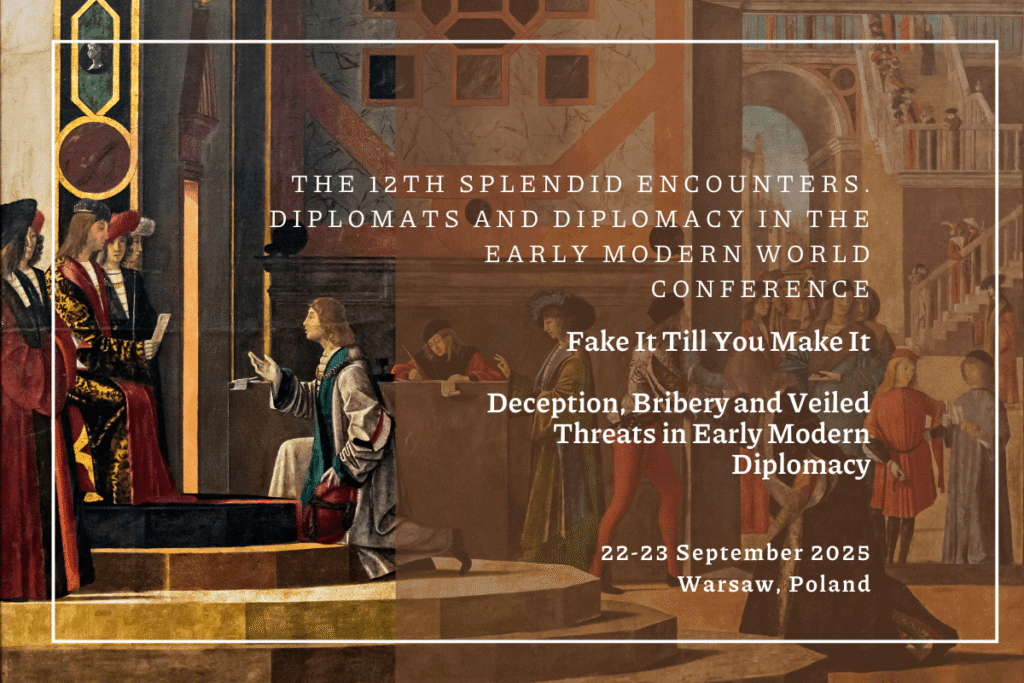
This is what all researchers of early modern diplomacy have been waiting for. After several years of
impasse due to the pandemic, the Splendid Encounters: Diplomats and Diplomacy in the Early
Modern World international conference series has been reactivated. This year’s event was held in
Warsaw. It was jointly organised by the Faculty of History of the University of Warsaw and the
Institute of History of the Polish Academy of Sciences. The 12 th edition, which took place on 22 and
23 September 2025, aimed to stimulate discussion about deception, threats, bribery, double-dealing,
and other dishonest practices in diplomacy within a global context from around 1500 to c. 1800.
[CLICK HERE TO SEE THE PROGRAMME – https://historia.uw.edu.pl/wp-
content/uploads/2025/08/SE12_Programme-1.09-1.pdf].
In the panel devoted to prosopographic research, Dr. Dorota Gregorowicz delivered a presentation
entitled Habsburg Dependences of the Post-Tridentine Apostolic Nuncios (1562–1605). A
prosopographic study of a group of 104 apostolic nuncios carrying out their missions in post-
Tridentine Europe (1562–1605) has demonstrated that a significant proportion of the papal
diplomats were concurrently engaged in direct relationships with one of the Habsburg courts of the
epoch (predominantly Madrid and Vienna, but also Graz, Innsbruck and Brussels). The nature of
these links was most often of a post-feudal character, originating from family traditions and usually
stemming from the geographical provenance of the diplomats from Italian territories under
Habsburg domination. However, it is noteworthy that some of such relationships were newly
established, driven by personal sympathies on the part of the nuncio and the pursuit of a powerful
patron, to gain personal advantages. These patterns indicate a clear early modern tendency among
the then non-professional corps of diplomats to have multiple loyalties. Dr. Gregorowicz’s paper
aimed to determine the scale of this phenomenon, its implications for the functioning of the papal
diplomatic network, as well as its perception by both the pope and the rulers who received individual
diplomats at their courts.